Operating View

Risk decides which capabilities run and how hot. Contracts decide how their work flows on. This page defines both.

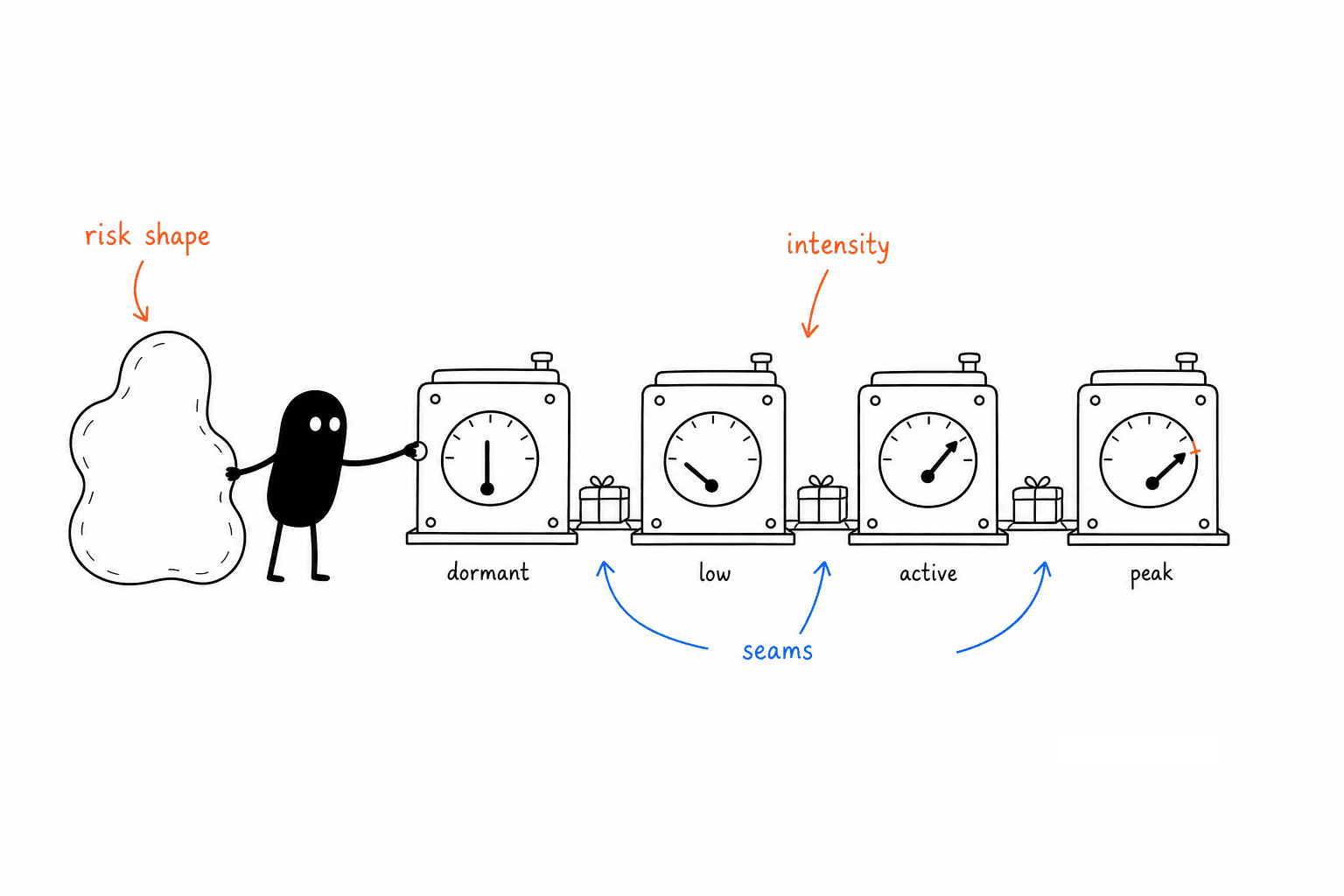
Risk turns intensity dials; work flows across seams.

Intensity

Every capability sits on a four-step dial at all times. The live risk mix moves the dials.

A risk is two questions, and they answer to different scales. Conflating them is what makes a risk register unreadable.

Question Answers to Behaviour
How much rides on it? Level Stable. It does not move as the work progresses — what is at stake was settled when the work was scoped.
How sure are we? Intensity Moves. Low confidence on something that matters drives its capability to Peak; as we prove it out, it cools.

The dial is a label on the capability, never on the risk or the product item.

Step Meaning
Dormant present but idle; re-activates on the right signal
Low live but light — a check or a spike
Active a primary workstream now
Peak the dominant demand

Dormant is not absent. Capabilities turn down, never off.

Risk shapes

The recurring kinds of "riskiest unknown." Each names an unknown, activates a set of capabilities at a dial, and produces an output that becomes available as input to whatever fires next. Shapes co-occur, recur, and persist — the order they fire in is not fixed.

Dial values are authored drafts. They have not been reviewed, and no page or document recorded them before now.

Seams

The load-bearing handoffs between capabilities. A seam is the interface between two capabilities: what must cross, in what form. This is the floor — the minimum for a valid handoff. It holds regardless of tool; AI carries the artifact across, judgment decides whether what crossed is right.

Commercial → Framing

Crosses

A scoped commitment — what's promised, at what confidence, what's still an open bet.

Not

A guarantee of outcomes we haven't earned.

Violated by

A SOW written as certainty: roadmap and deliverables promised as done before any risk is retired.

Framing → Building

Crosses

A testable definition — problem, outcome, constraints.

Not

A wish list.

Violated by

Requirements that can't be built or tested from.

Product & interface building ↔ Core systems engineering

Crosses

A runnable artifact — built in real components against the token system, extended in place.

Not

A static mock, a screenshot, or a written description of a screen.

Violated by

A screenshot in a ticket, or engineering rebuilding behavior from a description.

Building → Proof

Crosses

Evidence against a bar set up front.

Not

"Looks done."

Violated by

Acceptance on subjective sign-off.

Proof → Commercial

Crosses

A confidence-tagged commitment call — what the evidence now earns the right to scale, price, or commit, and what it doesn't.

Not

"We're done, here's the next phase."

Violated by

Scaling or re-pricing on the calendar instead of the signal, or a green light no signal backs.

When the work changes

A change lands mid-delivery. This is what it does to the shape of the work — six moves, in order, ending on the first thing to attack.

1 · Re-read the risk

Which risk shapes re-fire, which newly appear, which subside. Name the new riskiest unknown.

Invokes: Risk framing

2 · Re-set the dials

Per capability, the intensity shift and why. Flag dormant to active, where a capability surfaces that nobody was staffing, and peak to low, where work in flight may now be throwaway.

3 · Test the decision gate

Does the change cross the product-vision line? If it changes what the thing is, it re-opens go / redirect / stop — not a change order.

Never: Processing a vision change as a change order because the paperwork is easier.

Invokes: Direction qualification

4 · Re-staff

Which seats the new dials require, at what level. Where the needed level is unavailable, name the bench gap as a delivery risk rather than staffing under it.

5 · Re-price and re-time

One question, in two currencies: what does this cost, in money and in time. Emergence allowance or a new envelope — the test is whether it changes what it takes to clear a gate. Tier by confidence: fixed on proven, ranged on directional, gated spike on collapse risk. Name any new gate inserted. Then the timeline consequence, derived not negotiated — the date holds and scope flexes, the date moves by the validation spike, or the date holds and confidence drops.

Never: Letting the date hold on lower confidence without saying so out loud. That is the one outcome that must never be the default.

Invokes: Pricing under uncertainty, Confidence-based estimation, Commercial scoping & envelope shaping
6 · Name the next slice

One slice, testing one assumption, with the signal defined before it is built. The pass ends here because this is the point of running it — the first thing to attack, not a revised estimate.

Invokes: Slice building, Signal design

It proposes. L4s decide. It never silently absorbs a vision change.

Seams are checked throughout rather than as a move: a change that moves work across a seam without changing what crosses it is a smaller change than it looks.